
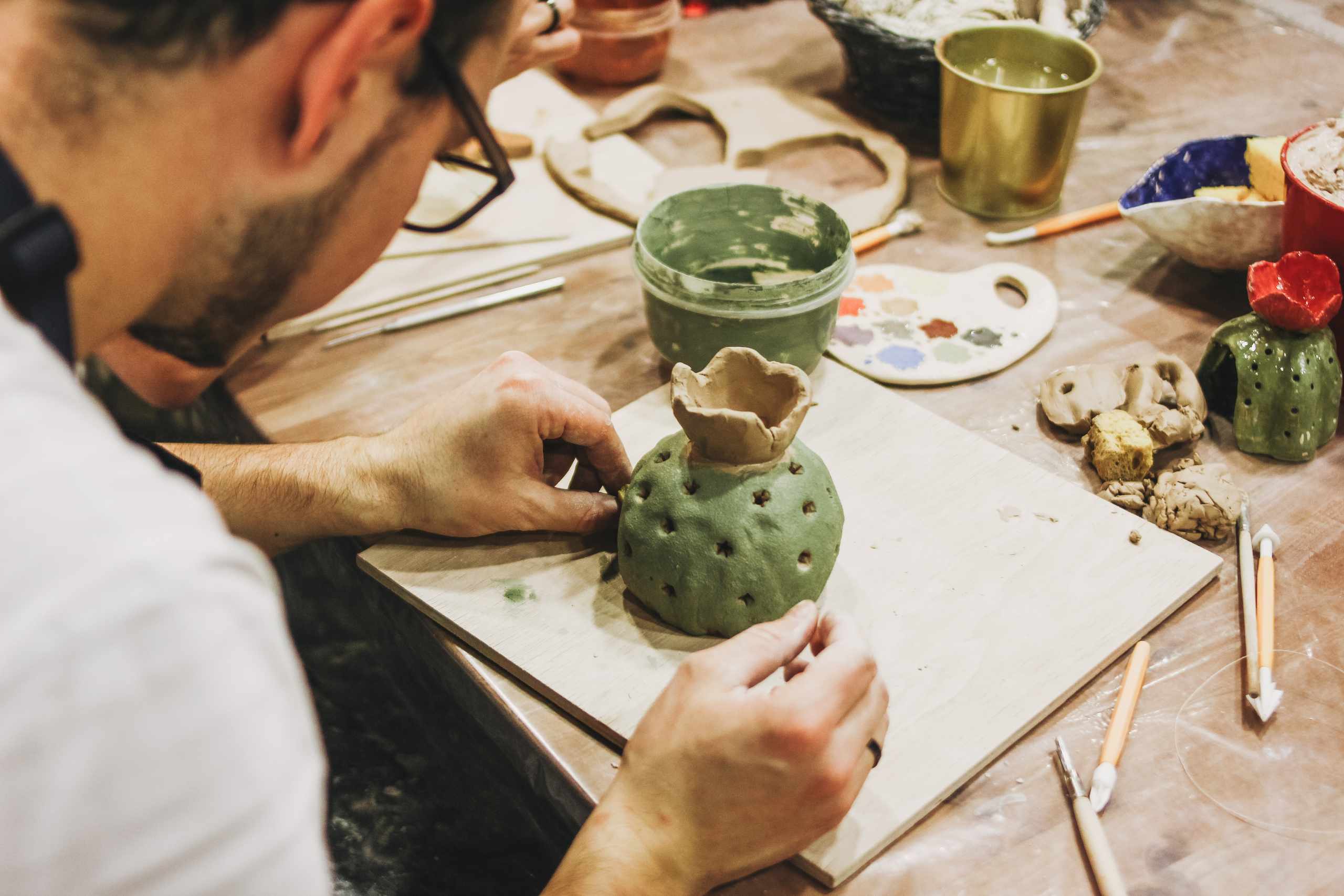
Pinch, coil, and slab building methods can all yield functional clay forms. Each method addresses specific structural issues. A pinch form is created by shaping one piece of clay. Coils add verticality piece by piece as they are layered and joined. Slabs are more planar and can be cut and joined to create flatter forms. How do you know which is best? Ask yourself what the final object will look like, not which method is most sophisticated. A cup, vase, and box all might need different starting points.
Pinching is ideal for building up a small object from one mass of clay. It allows direct manipulation of the wall. You can feel the change in wall thickness as you work and adjust as needed. It is great for building small vessels, simple pots, or small sculptures. The drawback is that the shape can become wider or distorted if too much pressure is applied. It is hard to keep uniform walls if you continue to pinch from the same area.
Coiling is useful when the object needs to get taller or wider. First, a base is built up. Then coils are added to it to extend its height. As the coils are added, the form can be pulled inward, outward, or upward. Coiling is ideal for vessels that cannot easily be pinched out of one lump. The drawback is that coiling requires careful joining of coils. If coils are only stacked on top of one another and not firmly joined, the seam will show and the form may break apart.
Slab building is ideal for forms that have more defined lines and edges. The form begins as a slab of clay that has been rolled or pressed flat. Slabs are good for forming boxes, trays, small structures, geometric sculptures, and other more angular forms. They must have a consistent thickness to hold together as they are assembled. A thin spot will behave differently than a thicker section. They must also be sturdy enough to support themselves as they are assembled. If they are too soft, the edges will become warped as they are lifted and joined.
Often a beginner chooses one of these methods because she prefers its look, even though the method may not suit the form. This leads to complications and reworking. For example, imagine you are making a simple cylindrical container. Pinching may be the best way if you want a simple round vessel. Coiling might be a better choice if you want to add height and change the profile. Slabs are the way to go if you want straight sides or an angular form. There is no right answer. The best way is the one that allows you to achieve the desired shape most easily.
Try comparing the methods by making three small open forms from similar pieces of clay. Make the first one by pinching. Make the second by starting with a base and adding several coils to it. Make the third from a small slab. Try to keep the designs very simple and avoid adding texture or decoration. As you work, pay attention to how it feels to maintain consistent walls, how each method creates seams or edges, and which methods are easier for you to manipulate without distorting the clay.
Before beginning a small project, consider the overall shape. If the form will be mostly round and compact, pinching may be the easiest way. If it will grow upward with curving lines, coiling will likely provide the best control. If there are large flat areas or sharp angles, slabs are probably the best choice. Selecting the building method according to the form’s overall shape will help you avoid having to change the shape during assembly. It will also free up more time for focusing on proportion, joints, rim shaping, and surface decoration once the structure is complete.