
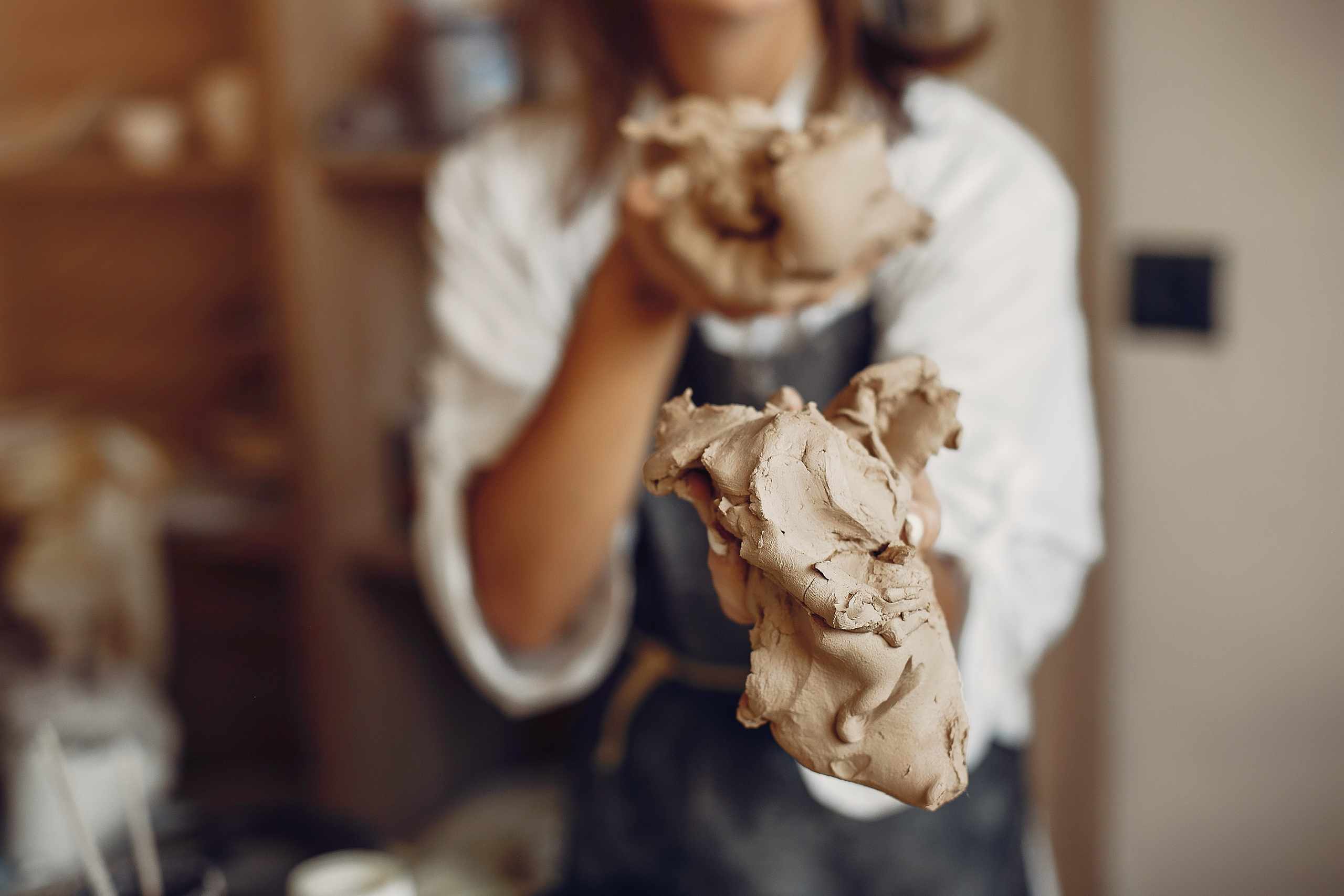
If you have a small clay bowl, it could have a balanced exterior and yet have a thick base, a paper-thin rim, and a heavy wall. These discrepancies can creep in as you pinch, press, and smooth the form. One hand presses harder on one side, the rim is thinned as you correct the shape, or the base remains thick as you leave it alone because it feels better to leave it that way. At first glance, the piece may still look good, but unequal thicknesses make your clay more difficult to work with as you continue to shape.
Thickness determines how the form will respond to your touch. A thick part will be less responsive to your fingers and will keep its shape, whereas a thin part will be more responsive and will be easier to move. When you squeeze a pinch pot to correct one side, the thin wall will begin to move before the thick part. This leads to further correction: you squeeze one spot and another part begins to move and the form becomes wider and misshapen. If you assess the thickness before you begin to work, you will save yourself from having to reshape the form too many times.
Your fingertips are one of the best tools for checking thickness. Rest your outside hand on the exterior of a wall and carefully feel the interior with your inside hand. Move your fingers around the form slowly. You do not want to squeeze; you simply want to feel. You aren’t trying to figure out the precise thickness of each wall; you are trying to find areas where the thickness has changed suddenly. If one part feels particularly heavy, gently compress and thin it down. If another part feels thin and weak, leave it alone and continue to work with another part of the form.
Pay special attention to the rim, which is easy to thin down inadvertently. As you repeatedly smooth and pull the form upward, or pinch it at the top, the rim may become much thinner than the body of the form. A very thin rim will also be easier to distort when you handle the piece. Rather than repeatedly rubbing the rim with wet fingers to smooth it out, compress the rim gently and check its thickness in various places around the form. The base can also get too thick. Many beginners will leave the base thicker than the walls, since the majority of their shaping takes place higher up.
Try this experiment: Make three small pinch forms from roughly the same amount of clay. On the first, focus on the exterior shape only. On the second, stop several times and use your fingertips to compare the thickness of the base, the middle walls, and the rim. On the third, intentionally leave one section much thicker than the others and observe how it responds when you try to alter the form. Don’t worry about making pretty pieces. The point is to get used to feeling the thickness before you actually see it.
Equal walls don’t mean that each millimeter needs to be the same. Some pieces will need to be thicker at the base or thicker in certain areas. But if you’ve unintentionally left a wall too thick or a rim too thin, it’s better to realize it sooner rather than later. Before you put down your small hand-built form, turn it around once, feel the walls, check the rim, and assess the base. If nothing feels particularly heavy, thin, or weak, your shaping will be more effective.